The Magical Wheel of Seasons
My story started the way most style journeys do: I was deeply unsatisfied with my wardrobe, wanted to experiment, but had absolutely no clue where to begin. Naturally, or should I say disconcertingly, the internet algorithm read my mind, and one day I scrolled my way onto something called seasonal colour analysis.
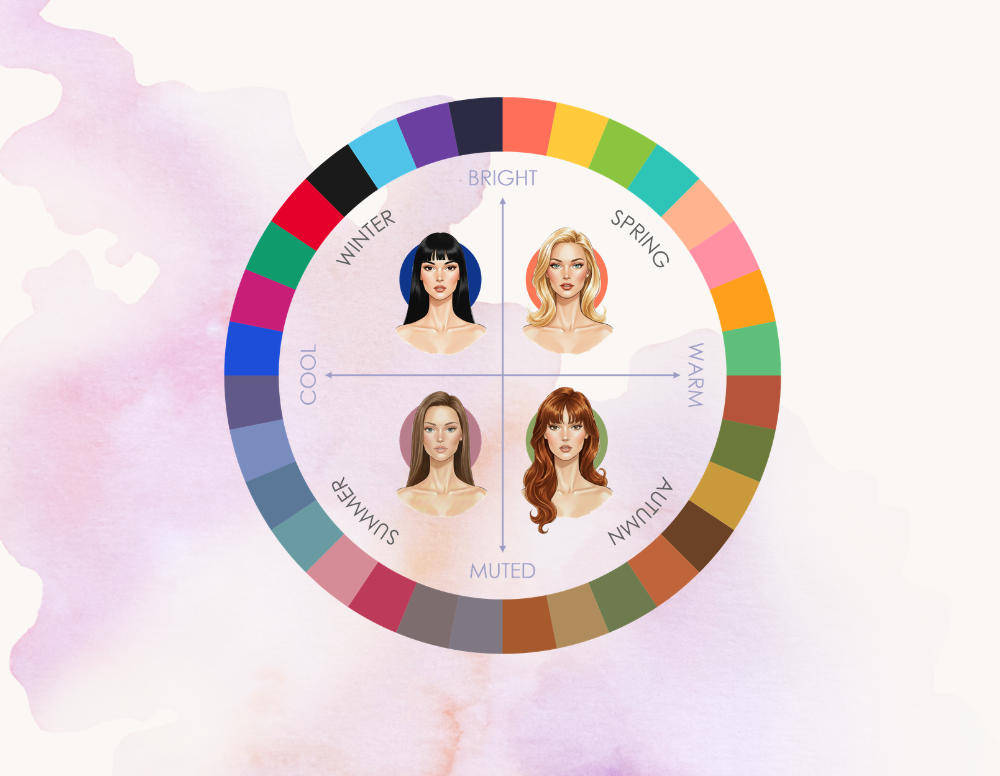
For the uninitiated, seasonal colour theory uses your skin, eye, and hair tones to find the palette that flatters you most. Everyone falls under one of four main “parent” seasons:
Spring, Summer, Autumn, and Winter.
Your colour season is determined by using three technical variables:
Chroma
How bright or muted your colours are.
Hue
Whether your undertone leans warm or cool.
Value
How light or dark your overall colouring reads.
The premise is simple: the colour of your skin, eyes, and hair all carry a certain hue, value, and chroma. So you’ll harmonise best with colours that fall into that same palette.
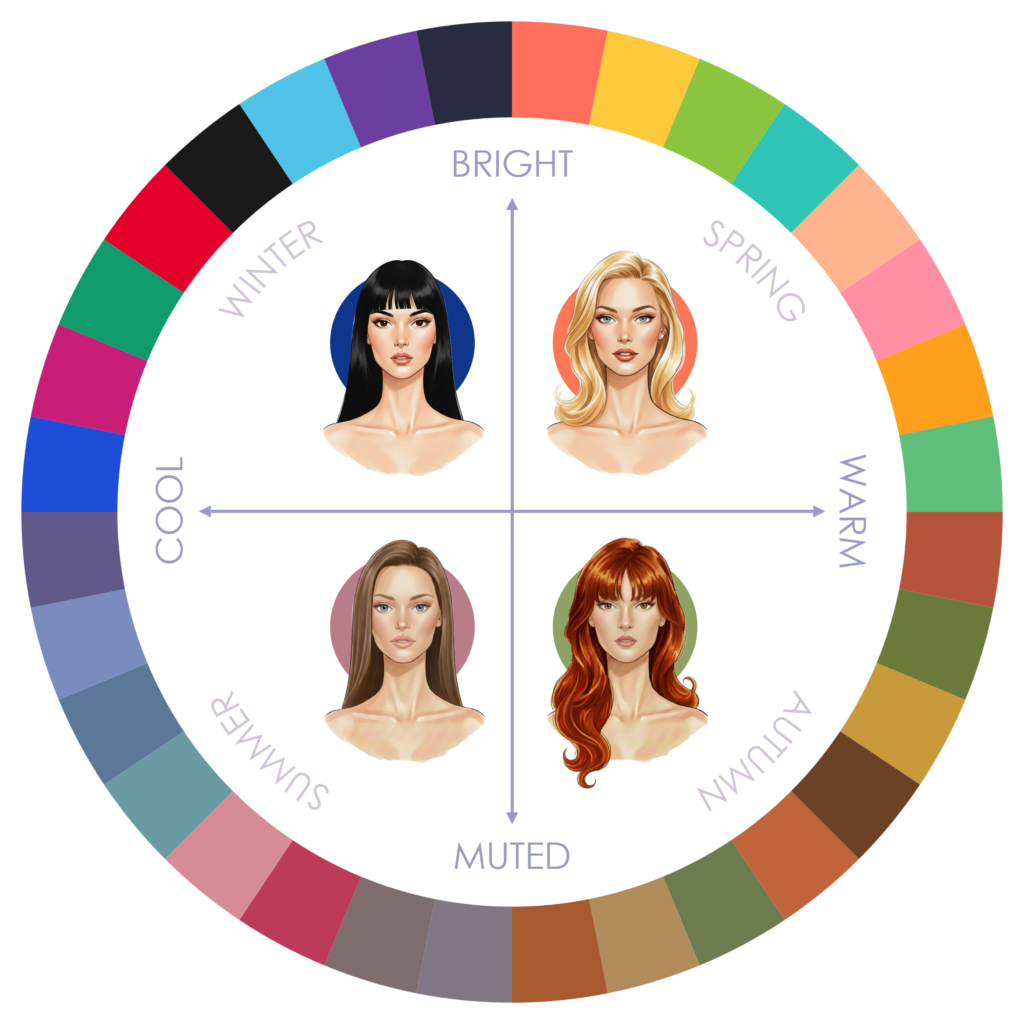
Spring is warm, light, and bright. Summer is cool, muted, and light. Autumn is warm, dark, and muted. Winter is cool, bright, and dark.
On paper, it looks like a perfectly logical flowchart. As a scientist, I was immediately intrigued. It promised something objective. It wasn’t just “wear this because it’s trendy”; it was rooted in colour analysis—cool versus warm, light versus dark, bright versus muted.
It felt logical. It felt like something I could solve.
Naturally, I tried to self-type…
The Traps of “Google Science”
Even though I read the theory (cool vs. warm, light vs. dark, bright vs. muted), and it all made sense on paper, I was still no closer to knowing which categories I fell into. The problem is that online definitions are almost too scientific.
Trying to figure out your own undertone or brightness level is pretty much impossible if you don’t have a trained eye and don’t know what to look for.
I tried the generic, entry-level tricks everyone starts with.
Do you look better in gold or silver, Do you look better in white or cream, Are your veins blue or green?
You can guess what happened. I had no clue. Everything looked exactly the same. I started wondering if I was some sort of neutral unicorn, or if the whole system was just a giant internet scam.
Gold or silver?
White or cream?
Blue or green?
My analytical mind was met with a paradox: the science made sense, but my eyes didn’t.
I buckled back down to reading articles and watching YouTube videos, but they all just repeated the same technical definitions over and over. Depth, brightness, undertone…
Yet, I was clueless about how to apply the theory in practice and no closer to knowing my season. So I read more articles and watched more videos, hoping that repeating the theory over and over would magically make it click.
It didn’t.
Yes, I could have gotten my colours professionally analysed, but I was a grad student. Spending money on that just wasn’t an option. Also, I am nothing if not stubborn
—I was determined I could get to the bottom of this.
So, I fell into the second common trap: Pinterest graphics…
The “European Blonde” Delusion
You know the graphics I’m talking about—the ones definitely not made by professionals. Blonde hair + blue eyes = Summer. Black hair + blue eyes = Winter.
According to those charts, because I have brown hair and brown eyes, I had to be an Autumn. It was the only category left that made sense. Plus, the Autumn palette had colours I really liked : deep burgundy, olive green, chocolate brown.
Autumn colours
Burgundy
Olive
Chocolate
On trend that season — not my season.
Looking back, those colours were just trending that season, which completely skewed my judgment.
There was another problem, too.
I had a wildly distorted view of my own colouring. In my head, I was this deep, luscious brunette. In reality? My hair is a standard Level 6 light brown—only one shade away from blonde.
This delusion can be attributed to the fact that I’m from Eastern Europe. Growing up there, if your hair isn’t practically platinum, nobody considers you blonde or light-haired. That cultural bias completely warped how I saw myself.
So, armed with my incorrect diagnosis, I went out, bought a few new pieces that fit the Autumn season, along with some gold jewellery.
And… nothing. I didn’t feel different. I didn’t look better. I just looked plain.
The scepticism came roaring back.
Is this even real?
The Missing Piece
For some time, I didn’t try to push it harder. I kept my research light. I was still exploring, but things barely made sense. I started watching colour draping videos, but I wasn’t convinced by them. How can these people see what looks better?! I felt dumb.
But then one day I stumbled on colour analysis expert @carolbrailey on TikTok. She was giving examples of her real clients, breaking down her process step by step. What to look for when typing someone: overall skin complexion, the jawline, wrinkles, discoloration, etc.
Finally, someone was explaining in a straightforward way what being in harmony with your colour actually looks like, not just using abstract phrases like the right colours will make you pop.
Things finally started to make sense.
I then concluded two things:
— one, seasonal colour theory is absolutely real; and two, it is both an art and a science!
Being able to spot the subtle differences a colour makes on a person takes skill. Skill that doesn’t come overnight, it comes with years of training your eye. I could not do what Carol does, that’s why she is the expert. And I was like a hypochondriac trying to self-diagnose using WebMD.
One thing was clear, I won’t become a professional colour analysis expert anytime soon. I for sure am not an artist, but I am a scientist, so in the name of science I started my experiment…